Wednesday, December 4, 2013

Saturday, October 5, 2013
Miami Dade Transit Fare Increase
While taking the cta in Chicago last Friday, I noticed
the fares were a dollar higher, compared to the $2.00 fare for Miami Dade
Transit. As of the 1st of October, Miami Dade Transit raised its
price to $2.25, not a drastic increase if you take the train occasionally, as
most Miamiams do. Then again, considering how inefficiently Miami Dade Transit
operates compared to any other transit system available in many regions of the
world, we should be curious as to why the fare is going up. Miami Dade Transit
has made notable changes in its service in the last year, with more and
revamped hybrid buses and the new Orange line metrorail to the airport. Nevertheless,
with higher prices, we should expect better service, for example, an automated
intercom person so riders can clearly hear the stops or transfer information.
Higher prices might be the only way to help MDT service a widespread metropolis as ours. According to Miami Dade
Transit, this is their first price increase in five years and its serves to
“defray operational costs.” Frequent transit users should expect physical
improvements and even those who use their cars must see the benefits in
increased funding for an extensive transit system. MDT should make more visible
improvements for example, fighting against a money-making scheme which could
turn the US1 buslane into a Miami Dade
Expressway Authority toll road or adding lightrail on the MacArthur Causeway to
make commutes between Miami Beach and Downtown more convenient.
This fare increase will pose an inconvenience for regular
riders with low incomes, those who are not eligible to hold Golden and Patriot
passports, and students carrying Easy Cards. This excludes non-senior citizens,
non- veterans, and those earning above $22,000 per year. Despite the price
increase, taking the Metrobus and Metrorail is still much more afforable than
owning a car, for which one must pay the costs of insurance, repairs, and
gasoline. Using transit is also safer than driving and its external costs such
as the environment and health are less severe. Nevertheless, the price increase
will definitely affect students, for example those without a car, travelling to
and from Miami Dade College Wolfson Campus or to and from Jackson Memorial Hospital will notice
that the one-month pass is no longer $100 but $112.50 and for middle-income
workers and students, this is still a big increase. While some frequent riders
might “grind their teeth,” as was described by one college student who uses the metro
to commute to and from Wolfson Campus everyday, if it helps save time and make
transit operations more efficient, the price increase will be worth it. Time is
money, after all.

Thursday, September 5, 2013
Ideas from Abroad: Urban Renewal
Read more at: Center for Arts and Urbanistics


Monday, December 31, 2012
Conclusion

Creative Spaces
Wrapping up a wonderful year of urban planning research and blogging with a post on creative spaces because there's nothing better.
Photos from Google Images
 |
| Redwoods Treehouse Cafe in New Zealand |
 |
| Mining Museum and cafe built in shipping container by Peter Zumthor |
Friday, December 28, 2012
The Semiotics of Urbanism: Urban Language
This year, city branding has gone to a whole new level. Apparently, ThisBigCity has begun to form a dictionary of city identities. It has helped certain places attract tourism and do well in economic competition. In order to reinvent themselves to become global destinations for culture, history, and wealth, cities have developed an urban language.
Branding is not a new thing. Until the twenties, Miami was only known by a select few beach dwellers. Then suddenly, the beautiful white sand was discovered, and economic opportunity sought as hotels began popping up. During and after the second world war, Miami evolved an identity with iconic figures such as Jackie Gleason, Art Deco design, Al Pacino in Scarface, and so on. Tourism for the wealthy and a life of luxury was what made Miami distinct. Today, when one says the word Miami, the word itself contains a lot of baggage. It could mean luxury, wealthy Latinos, beautiful people, international gateway, salsa music, house music, NBA champions, and very recently, art.
Other cities in the world have embraced similar branding technique. Now, as urbanism becomes a more popular trend, individual locations must carve a niche for themselves in the world economy by developing positive images that are natural, not just artificially created. ThisBigCity has tried its hand at semiotics this time, finding out that this new dictionary of places tells us a lot about the deeper connotations (positive or pejorative) we give specific cities when we mention them or use them as a part of speech.
Some examples?
Branding is not a new thing. Until the twenties, Miami was only known by a select few beach dwellers. Then suddenly, the beautiful white sand was discovered, and economic opportunity sought as hotels began popping up. During and after the second world war, Miami evolved an identity with iconic figures such as Jackie Gleason, Art Deco design, Al Pacino in Scarface, and so on. Tourism for the wealthy and a life of luxury was what made Miami distinct. Today, when one says the word Miami, the word itself contains a lot of baggage. It could mean luxury, wealthy Latinos, beautiful people, international gateway, salsa music, house music, NBA champions, and very recently, art.
Other cities in the world have embraced similar branding technique. Now, as urbanism becomes a more popular trend, individual locations must carve a niche for themselves in the world economy by developing positive images that are natural, not just artificially created. ThisBigCity has tried its hand at semiotics this time, finding out that this new dictionary of places tells us a lot about the deeper connotations (positive or pejorative) we give specific cities when we mention them or use them as a part of speech.
Some examples?
L.A.: adj.
1. Glitzy, glamorous, opulent
2. Dirty, dangerous, dingy
3. Weird
4. A less-European synonym for cool
1. Glitzy, glamorous, opulent
2. Dirty, dangerous, dingy
3. Weird
4. A less-European synonym for cool
Berlin: adj.
1. A space that melds together elements of high and vernacular culture
2. A space that combines oppositional elements
3. Synonym for cool
1. A space that melds together elements of high and vernacular culture
2. A space that combines oppositional elements
3. Synonym for cool
Brusselise: v.
1. A process of urban densification that lacks planning foresight
2. Maintaining a ‘hands-off’ approach in urban planning
3. Pejorative term for placing buildings in a neighbourhood in which they do not fit
2. Maintaining a ‘hands-off’ approach in urban planning
3. Pejorative term for placing buildings in a neighbourhood in which they do not fit
Vancouverise: v.
1. A process of densifying a neighbourhood in a way that mitigates the negative effects of high-density living
2. Consistent implementation of a tower-and-podium architectural typology
3. Planning a city to take advantage of spectacular natural surroundings
2. Consistent implementation of a tower-and-podium architectural typology
3. Planning a city to take advantage of spectacular natural surroundings
Read in detail: http://thisbigcity.net/reinventing-cities-new-urban-language/
Reposted from ThisBigCity.... Loved this article.
What Gangnam Style Says About Wealthy Neighborhoods Worldwide

Gangnam style: on the surface its success seems to be a story of the raw power of the internet. A flamboyant South Korean rapper, though he sings in a language most of us don’t understand, produces a single with an addictive beat and visuals eye catching enough to make the video go gangbusters via Facebook shares. The song becomes the most watched video ever on Youtube, and a radio hit in countries around the world.
Certainly no one can deny that the craftily conceived video is a huge factor in the success of Gangnam style; the oddly suggestive “horse” dance has become world famous. And those curious enough to look up the translation find that despite the explicit nature of the video, which among other things features a lewd dance in an elevator by a guy stripped down to his briefs, rapper Psy’s lyrics are actually about how he wants to date a woman who drinks coffee.
Beneath the bump and grind of the video, Psy fills his lyrics with wry jabs at the upper class denizens of the wealthy Gangnam neighborhood of Seoul. The apparently incoherent line “I like a girl who drinks coffee” is actually a dig at the social climbing women who spend more money than they can really afford at coffee shops.
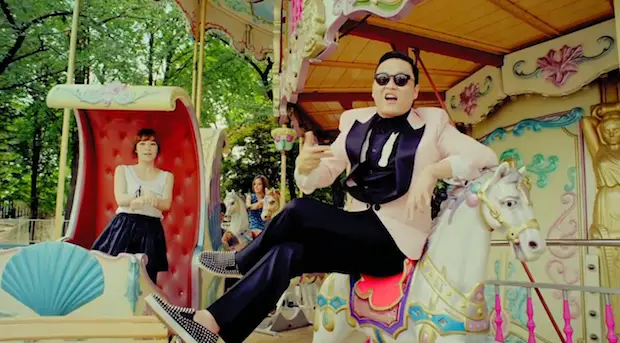
But can the success of Gangnam Style be chalked up to zany perverted visuals, sly lyrics, and savvy use of the internet? As anyone who lives in a large city anywhere in the world can attest, there’s a bit more to it than that. That’s because every big city in the world has its own Gangnam, its own high profile neighbourhood, which to rich and poor alike serves to entice and irritate in equal measure.
As portrayed in the video, Gangnam is an extreme blend of public and private. The district features a number of public plazas and parks, most of which are well maintained. Gangnam serves the important function of providing memorable public landmarks. And like most rich neighborhoods around the world, it is a major tourist destination, and was already a tourist hot spot even before the onslaught of “Gangnam style” related visits. The area is also home to well-protected, exclusive areas such as the horse corrals seen in the beginning of the video. This is a perfect archetypal rich neighborhood; Gangnam could easily be New York’s Upper East Side or Paris’s Champs Elysees. Even countries traditionally considered to be less wealthy feature similar neighborhoods. Take a trip to Mexico City or São Paulo and you’ll find they have Gangnam districts of their own.

The essence of the Gangnam neighborhoods of each and every city worldwide is the deft manipulation of public and private ways of life. Seoul’s elite are happy for throngs of visitors to enjoy public plazas, or the now famous duck boats of Hangham park seen in the Gangnam style video. But they don’t want the unwashed masses to come inside their highbrow riding clubs, only a few blocks away. A more extreme example of this was seen last year during the Occupy Wall Street protests in New York. The public/private Zucotti Park, which wall street bigwigs were normally happy to have open to the public, was quickly flipped to private mode after it became the epicenter of a nationwide protest movement that business leaders didn’t exactly fancy. With austerity movements in Europe and the United States, the trend toward increased privatization is only growing.
In this context, Gangnam Style can be seen as an act of revolution, albeit a metaphorical one. Psy models his dance after the most exclusive action taken in the neighborhood (horseback riding) and brings it to the parks, plazas, and curiously-shaped boats of the district. And the citizens of the world, tantalysed by the opulence yet troubled by the excessive exclusivity, are thrilled to see this. Deep down inside every middle class city dweller, there’s a desire to rail against the divisions built into the Gangnam district of his or her own city, and what better way to do so than with a stingingly satirical horse dance?
So, while Gangnam Style will continue to proliferate mostly due to the dry humour of its lyrics and the dry humping in its video, the subliminal connection it makes with city dwellers yearning for a little less exclusivity in their own Gangnam neighborhoods will also continue to resonate.
Drew Reed is an online media producer and community activist specializing in sustainable transportation. He lives in Buenos Aires.
Subscribe to:
Posts (Atom)